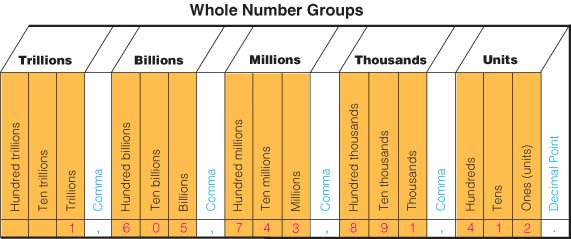
In our number system, a numeral is made up of groups of numbers called periods. Each period contains three columns - a hundreds, tens, and ones column - and each is separated from the next period with a comma. Here's a number that fills five periods:
163,321,987,654,322
You read this number as one hundred sixty-three trillion, three hundred twenty-one billion, nine hundred eighty-seven million, six hundred fifty-four thousand, three hundred twenty-two. Remember: as you move to the left, each numeral has a value ten times greater than the same numeral would have in the previous place: the 2 in the tens place stands for a value ten times larger than the 2 in the ones place, and the 3 in the trillions place stands for a value ten times larger than the 3 in the hundred billions place. That is how our base-ten number system, also known as the decimal system, works.
WATCH THIS VIDEO
Key Notes:
- Periods: numeral made of groups of numbers - period contains 3 columns (hundreds, tens, ones)
- Periods are separated by a comma
- EXAMPLE: 163,321,987,654,322
- Each number from right to left is 10 times higher than the number before it
- EXAMPLE: 63 (60 + 3) - 3 is in the ones spot and 6 is in the tens spot
- When writing numbers in word form, the comma stays in the same spot
- EXAMPLE: 234,302 = two hundred thirty-four, three hundred two
- When no numbers are in that spot you have nothibng to write
- EXAMPLE: 32,000,000 = 32 million / 3,700,000 = 3.7 million

No comments:
Post a Comment