A revolution is a big change. Before the American Revolution, the British settlers in America were colonists, ruled by a faraway king. After the revolution, these same people were independent citizens, governed by their own elected officials.
Revolutions take place in scientific thought as well. In the 20th century, the theory of plate tectonics has revolutionized our understanding of our planet. Before this revolution, scientists believed the continents did not move. Nowadays, scientists believe that the continents and the whole surface of the planet Earth are in constant motion. Plate tectonics helps us understand why the continents are where they are, and where they were long ago,. It also tells us how mountains are built, why volcanoes sometimes erupt, and where earthquakes are most likely to shake the land.
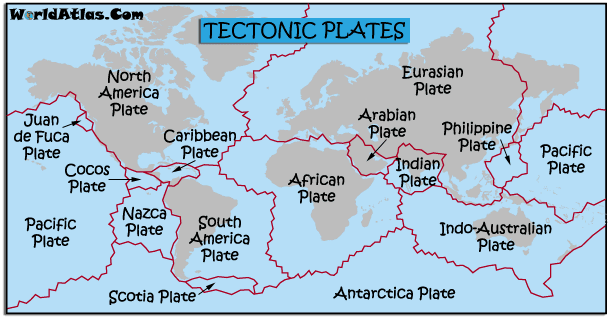
The theory of plate tectonics, accepted by virtually all geologists, holds that Earth's surface, or lithosphere, is composed of about a dozen major tectonic plates. These plates are large rigid slabs of rock that move very slowly, in part because of movements in the mantles below them. The plates move 5-10 centimeters a year, depending on their location. That may seem extremely slow; but if you remember that Earth is very old, you can see how small movements can add up over time. If a plate moves 2 inches a year, it will move more than 30 miles in a million years, and more than 300 miles in 10 million years.
Key Notes:
- Plate tectonic theory created in 20th century
- Whole surface of Earth is in constant motion
- Lithosphere is composed of 15 tectonic plates
- Tectonic plates are large rigid slabs of rock that moves slow because of mantle
- moves 5-10 cm a year
- Draw plate map and label with correct names.

No comments:
Post a Comment